Integration work keeps changing.
Every new system brings its own tools, semantics and failure paths. Someone must discover and maintain the connection.
We're building The Construct: an AI execution environment designed to investigate unfamiliar software, discover usable capabilities, perform authorized operations, verify the result and retain what holds up.
A new vendor API. An undocumented desktop action. A workflow that fails after the first external write. Each variation creates more manual discovery, glue code and recovery work.
That long tail is where the next class of agent must prove its value—not by producing another answer, but by handling unfamiliarity responsibly.
Every new system brings its own tools, semantics and failure paths. Someone must discover and maintain the connection.
After a partial failure, replaying the old workflow can duplicate an action. Recovery must inspect what truly happened.
An adaptable execution environment could turn carefully verified solutions into transferable capability, without making behavior its own authority.
FROM ONE-OFF FIXES TO REUSABLE KNOW-HOWThe Construct is being designed around a real runtime. Models can advise on unfamiliar work. A separate execution authority determines which tools are admissible, records what happened and asks the environment whether the objective was actually met.
Discover actual interfaces and contract limits. Neither a model's confidence nor a tool's presence grants permission.
A canonical runtime admits operations and carries receipts across the work instead of scattering control among agents.
Inspect real effects, handle contradictory evidence and qualify methods for use in future environments.
Our target architecture—not a claim that universal autonomy is already complete. See the implemented foundation and next acceptance milestone →
Our initial design-partner hypothesis is engineering and operations teams maintaining integrations and workflows across changing tools. These are three testable problem classes—not fictional customer deployments.
The objective requires connecting an unfamiliar API to an existing application. The documentation, authentication, response shapes, and failure conditions are not yet known.
Which interface is applicable; what the service permits; which assumptions need testing.
The intended change is visible in the destination system, with the source, permission, and outcome recorded.
Real interface captures from the local Windows build. Explore the working surfaces, then see what the engineering has—and hasn't—proved.
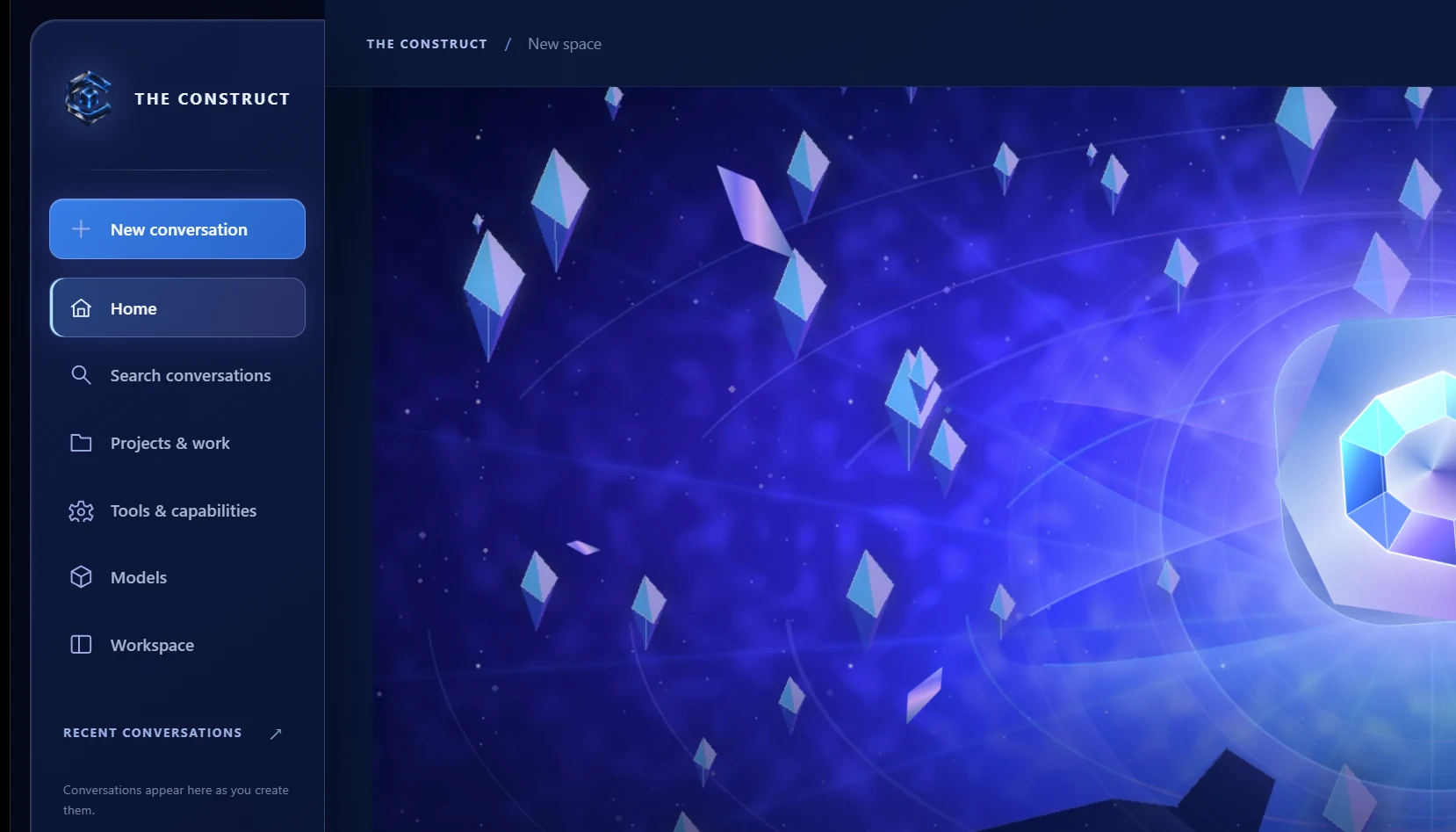
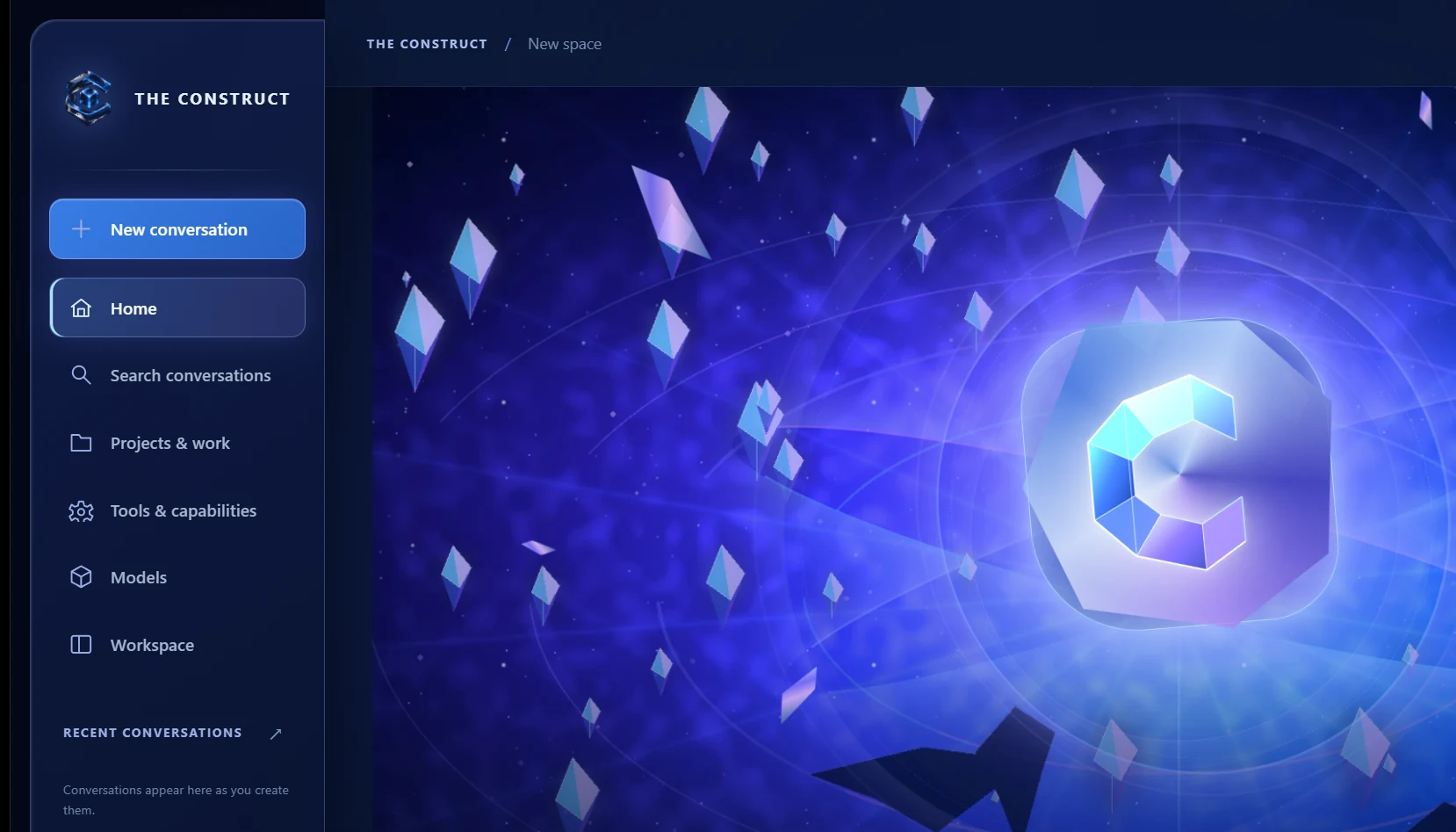
Start with an objective. From there, conversation and work surfaces stay connected to the same task instead of fragmenting into unrelated screens.
THE LIVING CANVAS / 01Bring a dataset. Compare two versions of a record. Follow the connections back to their source. Each result is produced by code running in your browser, using the information you provide.
Open the workbenchIn the desktop environment, the Spatial Rift opens the connections around selected work. Records, sources, and observations remain tied to the objective that gave them meaning.
✳ THE CONSTRUCT / CONTEXTUAL SPACEThe Construct's foundation is built around admitting specific operations, preserving work history, and distinguishing a claimed result from a verified one.
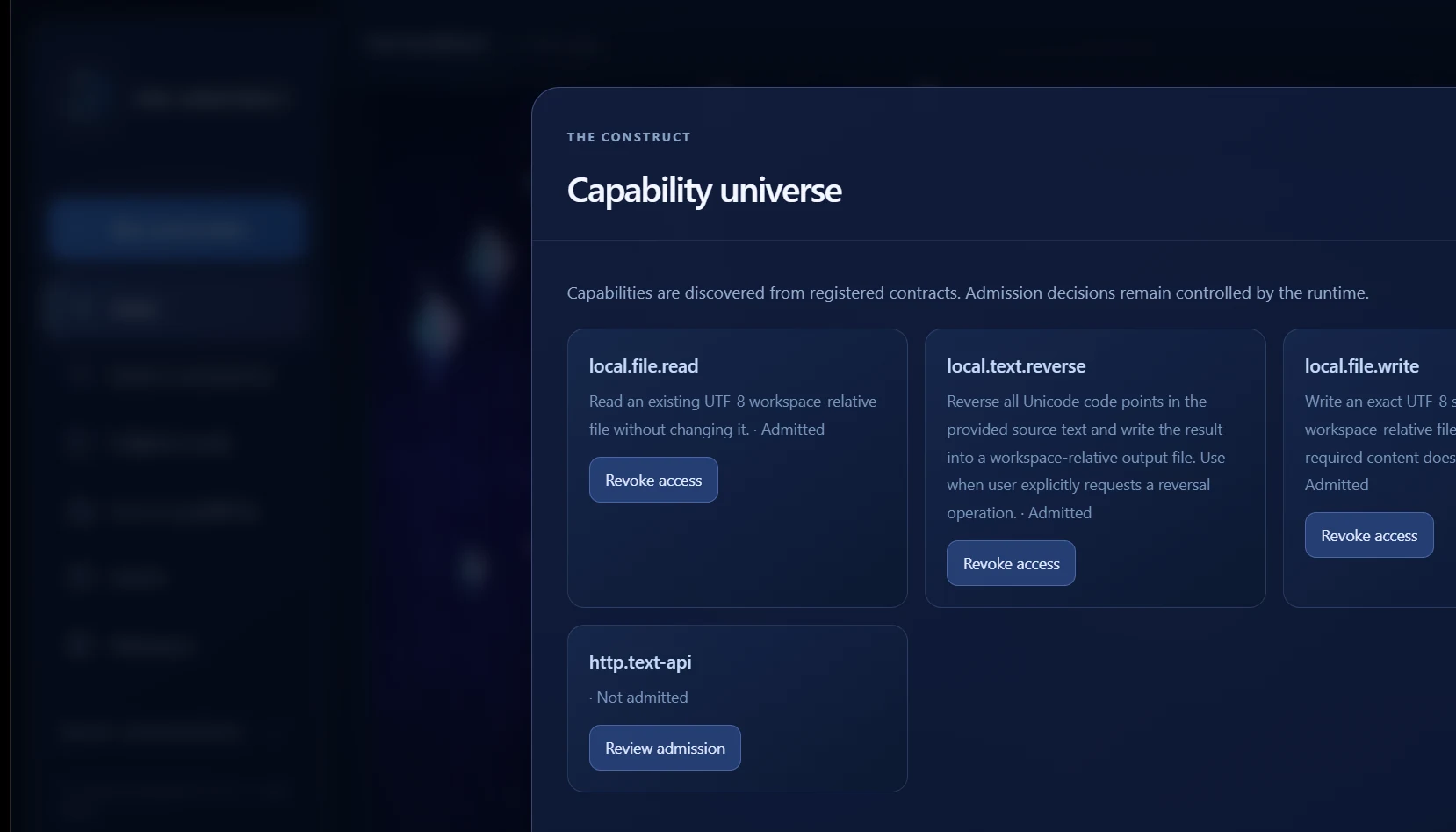
The runtime coordinates admitted operations. Model-generated suggestions don't become system permissions.
Local operations and scoped MCP, OpenAPI, and source integrations enter through declared tool interfaces.
Execution receipts, source snapshots and the local event history support inspection of what actually occurred.
The Living Canvas, Lattice and Focus Chambers present available records and context without creating another controller.
The product is a working desktop foundation under active development. Verified narrow capabilities are the beginning, not evidence that every future objective can already be completed autonomously.
The important distinction isn't between a beautiful prototype and an ambitious plan. It's between code that exists, behavior that has been observed, and the larger objective that still has to survive a real-world test.
Typed local, MCP, OpenAPI and scoped source operations; a transactional work ledger; permission-bound operation interfaces; and the Electron desktop.
CODE / UNIT TESTSSpecific local text operations, an OpenAPI effect, source acquisition with tamper detection, browser navigation, and inspection through the desktop work surfaces.
BOUNDED EXECUTION / NOT UNIVERSALTake an unfamiliar objective end to end. Discover and admit what it needs, recover from a real failure, verify the external outcome, and reuse the learned method after restart.
NOT YET VERIFIED END TO END
ShellShockHive is developing The Construct as a desktop-first adaptive intelligence product. Our first conversations are for technical teams, builders and operators whose work crosses unfamiliar systems and can't be reduced to a reliable static workflow.
The opportunity is a system that retains qualified know-how instead of treating every novel task as a fresh chat. That advantage has to be earned through repeatable real-world outcomes; that's what we're building toward.
Explore the venture and pilot approach ↗A hard integration. A brittle workflow. An unfamiliar system. We're looking for substantive technical conversations, tightly scoped pilot challenges and partners who care about proving the result.
shellshock@shellshockhive.comSee the partner brief →